Bitcoin’s Grand Finale: When the Last Coin Will Be Mined and What Comes Next
When Will the Last Bitcoin Be Mined? The Grand Finale
Bitcoin, often called ‘digital gold’ by people who definitely own some, operates on a very simple, very strict rule: scarcity. There can only ever be 21 million coins. This finite limit begs a question that keeps crypto enthusiasts up at night: when will the last bitcoin be mined, and what on earth happens then? Will the internet just… end? This post dives into Bitcoin’s quirky monetary policy, its predictable diet plan known as the halving, and what the future holds when the well finally runs dry.
Table of Contents
- Bitcoin’s 21 Million Cap: Why You Can’t Just Print More
- The Halvening: Bitcoin’s Built-in Diet Plan
- The Long Goodbye: Pinpointing When the Last Bitcoin Will Be Mined
- After the Final Block: What Happens After All Bitcoin Are Mined?
- To the Moon? Bitcoin’s Value in an Era of Maximum Supply
Bitcoin’s 21 Million Cap: Why You Can’t Just Print More
Let’s get one thing straight. The bitcoin supply limit is not a gentle suggestion. It’s the law of the digital land, etched into its very code by the mysterious Satoshi Nakamoto. This is the core of its design.
Satoshi’s Master Plan for Digital Scarcity
While central banks have their money printers perpetually going “brrr,” Satoshi decided to build a system with a hard stop. The bitcoin 21 million cap was a deliberate choice to create a deflationary asset. The idea was to mimic the scarcity of precious metals like gold. You can’t just wish more gold into existence, and you certainly can’t CTRL+P more Bitcoin.
This fixed supply is the foundation of bitcoin scarcity, a feature that makes economists either nod in approval or furiously write angry letters. There’s no committee that can vote for a “Bitcoin stimulus package.” The number is the number, and that’s that.
A Deflationary Diva in a World of Inflation
This makes Bitcoin the ultimate diva in a world of ever-expanding fiat currencies. It sits in the corner, knowing its supply is finite, while dollars, euros, and yen are created with a few keyboard strokes. This predictable supply schedule is one of its most powerful and debated features. It’s a stark contrast to traditional finance, and for many, a welcome one.
Changing this rule would require a massive network-wide agreement, known as a hard fork. Getting millions of users, miners, and developers to agree on something so fundamental is practically impossible. It would be easier to get the entire world to agree that pineapple on pizza is a culinary masterpiece.
Is It *Really* Unchangeable?
Theoretically, yes, the code can be changed. But practically? Not a chance. The consensus mechanism that governs Bitcoin is designed for security and stability. A proposal to alter the bitcoin maximum supply would be met with such fierce opposition it would likely create a separate, less-valued version of Bitcoin, leaving the original intact. The social contract is just too strong.
The Halvening: Bitcoin’s Built-in Diet Plan
So, if new Bitcoins aren’t printed, where do they come from? They are “mined” into existence. Miners use powerful computers to solve complex puzzles, and as a reward for securing the network, they get a prize: brand new Bitcoin.
What on Earth is a Bitcoin Halving?
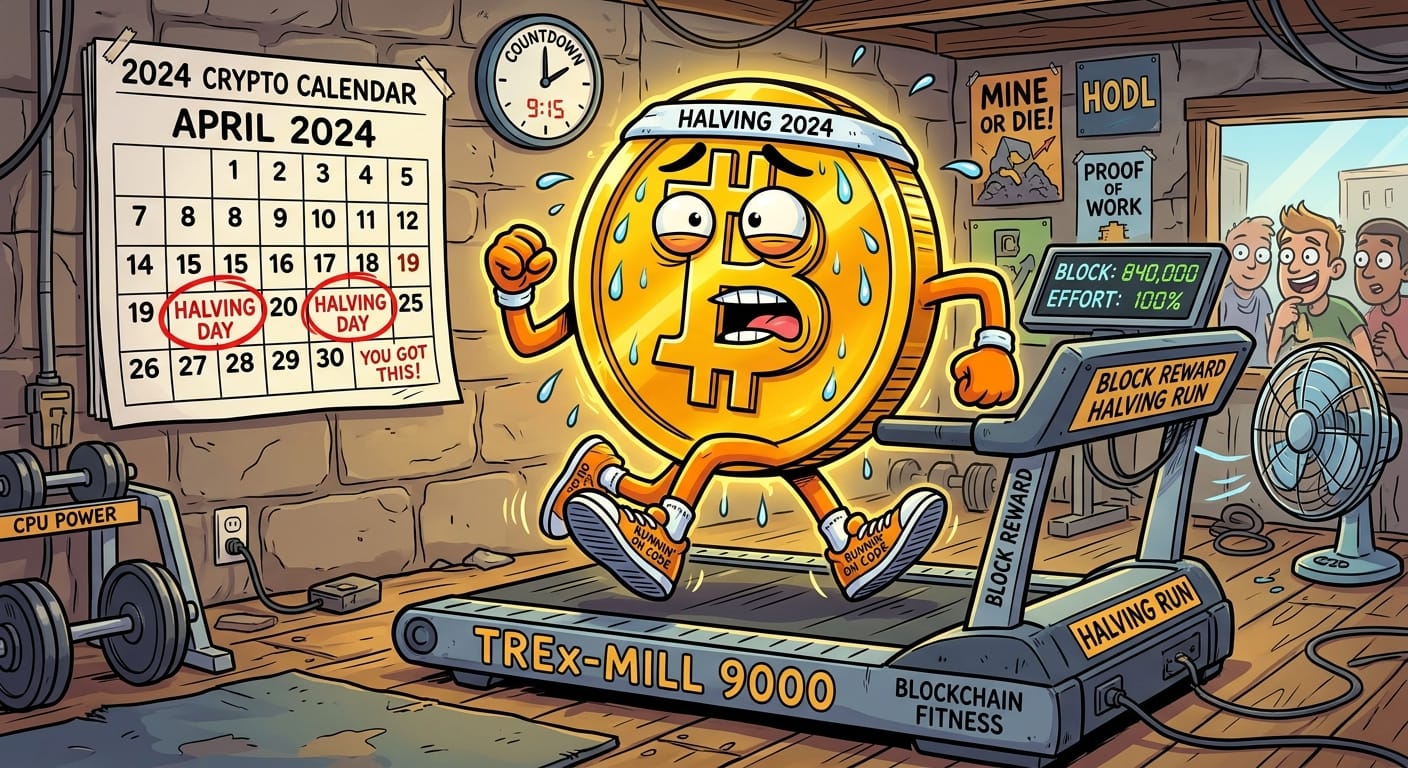
Imagine a magical pizza that gets delivered to your door every 10 minutes. For the first four years, it’s a large pizza. Then, suddenly, it becomes a medium. Four years later, it’s a personal pan pizza. After that, it’s just a sad, single slice. That’s the Bitcoin halving. Approximately every four years (or 210,000 blocks), the bitcoin mining rewards are sliced in half.
This process is automated and predictable, following the bitcoin halving schedule. It’s a core feature that controls the rate of new coin creation, ensuring the 21 million cap isn’t hit too early. It’s Bitcoin’s way of pacing itself, like a marathon runner saving energy for the final mile.

The Rhythm of the Blocks
This halving event is a major topic of discussion in the crypto world. People watch the block count tick closer to the next halving date like it’s a New Year’s Eve countdown. The most recent halving occurred in April 2024, cutting the reward from 6.25 BTC to 3.125 BTC per block. The next one is expected around 2028. Each bitcoin halving date is a milestone that tightens the supply, often leading to wild speculation.
Why Does This Even Exist?
The halving mechanism serves two critical purposes. First, it implements a gradual, controlled release of new coins, preventing a sudden flood that would devalue the currency. Second, it extends the mining reward period for over a century, giving the network ample time to mature and develop a robust fee market. It’s a genius bit of economic engineering packed into code.
The Long Goodbye: Pinpointing When the Last Bitcoin Will Be Mined
Now for the main event, the question on everyone’s mind: when will the last bitcoin be mined? The answer is both surprisingly precise and incredibly far away. Don’t hold your breath, because it’s not happening anytime soon.
The Year 2140: Mark Your Calendars (Maybe)
The current projections estimate that the final slivers of the last Bitcoin will be mined around the year 2140. That’s right, over a century from now. Your great-grandchildren might be the ones to witness this historic digital event, probably on their neural implants while vacationing on Mars. This distant date is a direct result of the halving schedule.
As the block reward gets smaller and smaller, it takes longer and longer to mine the remaining supply. The final reward will be a minuscule fraction of a Bitcoin, an amount so small it’s called a “satoshi.”
The 95% Club: Why the Party is Almost Over
Here’s a fun fact to blow your mind: despite the 2140 end date, over 19.7 million Bitcoin—or more than 93% of the total supply—have already been mined. The question of how many bitcoin left to mine has a surprisingly small answer. We are in the endgame, but the endgame is going to last for 120 years.
The remaining supply will enter circulation at an excruciatingly slow pace. It’s like trying to squeeze the last bit of toothpaste out of the tube, but the tube is 100 miles long. You can build an entire crypto news site using a platform like WordPress and it will still be relevant by the time this all finishes.
The Slowest Drip in History
By the 2040s, the block reward will be less than 0.1 BTC. By the end of the century, miners will be competing for mere satoshis. This slow, predictable drip ensures that the concept of new supply gradually fades away, rather than stopping abruptly. The network will have plenty of time to adapt to a new economic reality.
After the Final Block: What Happens After All Bitcoin Are Mined?
So, the year is 2140. The last satoshi has been mined. What now? What happens after all bitcoin are mined? Do the miners pack up their supercomputers and go home? Does the network just switch off? The short answer is no, but things will definitely change.
The Great Miner Pay-Cut: From Rewards to Tips
Once the block rewards disappear entirely, miners will have a new primary source of income: transaction fees. Every time someone sends Bitcoin, they can attach a small fee to prioritize their transaction. These fees all go to the miner who successfully validates that block of transactions.
Miners will transition from being rewarded with new currency to being paid for their service of securing the network. They’ll become the digital toll collectors of the Bitcoin highway, ensuring traffic flows smoothly and securely. For a glimpse into this future, you can start trading on OKX to see how fee markets already operate.

Will the Network Collapse? (Spoiler: Probably Not)
A common concern is whether transaction fees alone will be enough to incentivize miners to keep the network secure. If the revenue isn’t high enough, miners might shut down their operations, leaving the network vulnerable. However, the theory is that as Bitcoin’s value and adoption grow, the collective value of transaction fees will rise to a level that is more than sufficient to pay for security.
A single block could contain thousands of transactions. Even a small fee on each, multiplied by a high Bitcoin price, could result in a substantial payday for the lucky miner.
The Fee Market Frenzy
In this future, transaction fees will likely be more dynamic and competitive. During times of high network congestion, users will have to bid higher fees to get their transactions processed quickly. This creates a free-market system for block space. You could even launch a marketing campaign for a service on this new internet with a tool like Systeme.io, all paid for with satoshis.
To the Moon? Bitcoin’s Value in an Era of Maximum Supply
The completion of Bitcoin’s issuance schedule will be a monumental event. A major global asset will have reached a state of absolute, unchangeable scarcity. This has profound implications for its value proposition and its role in the global financial system.
The Scarcity Squeeze: Digital Gold Gets Real
With a truly finite supply, the only thing that can change is demand. If demand for Bitcoin continues to grow—whether as a store of value, a medium of exchange, or a hedge against inflation—its price, in theory, must go up. The bitcoin maximum supply transforms it from an asset with dwindling inflation to one with zero inflation, forever.
This could cement its narrative as “digital gold.” Unlike gold, whose total supply is unknown and can increase with new discoveries, Bitcoin’s supply is perfectly transparent and fixed. This could make it the ultimate safe-haven asset in the digital age.
Economic Theories on Absolute Finite Supply
Economists will be having a field day in 2140. An asset with a perfectly inelastic supply is a fascinating thought experiment. It could become a unit of account or a global reserve asset that other currencies are priced against. Its stability could become its greatest strength, a bedrock in a volatile financial world.
Of course, this is all speculation. But the potential is undeniable. This new digital economy will need its own storytellers and marketers, who can automate their work with tools like JetPack for social media auto publisher.
Building on Bedrock: The Future of the Bitcoin Ecosystem
A stable, finite base layer allows for incredible innovation to be built on top. Technologies like the Lightning Network are already enabling faster, cheaper transactions. In a post-mining world, the ecosystem of applications and services built on Bitcoin’s secure foundation could explode. If you’re building one of these, you’ll need the best infrastructure, maybe even from a provider like ResellerPanel.
Conclusion: The Beginning of a New Era
The mining of the last Bitcoin around 2140 won’t be an ending, but a graduation. It will mark the moment the network becomes a fully mature, self-sustaining economic system, running entirely on transaction fees. This pre-programmed journey from issuance to pure scarcity is a core part of Bitcoin’s genius and its enduring appeal.
Understanding this intricate, century-long schedule provides a crucial glimpse into the grand vision for a decentralized, robust, and truly finite financial system. It’s a marathon, not a sprint, designed to outlast us all. So, while we won’t be around to see the grand finale, we get to watch the most fascinating parts unfold.
Ready to be part of this financial revolution? Tap the link below to get up to AED 750 when you start trading on OKX and secure your piece of the finite future!
Discover more from YuRaFa
Subscribe to get the latest posts sent to your email.





Leave a Reply