The UAE’s Digital Dirham: Revolutionizing Payments in the Emirates

The UAE’s Digital Dirham: Revolutionizing Payments in the Emirates
The United Arab Emirates (UAE) is on the cusp of a major financial transformation with the impending launch of the Digital Dirham, its central bank digital currency (CBDC). As a blockchain-based digital version of the Emirati Dirham (AED), this initiative aims to modernize the nation’s payment systems, enhance efficiency, and integrate seamlessly with global financial networks. With a planned rollout in the fourth quarter of 2025, the Digital Dirham represents a key pillar of the UAE’s ambition to become a leading hub for digital innovation and fintech.
123 This comprehensive guide explores what the Digital Dirham is, its features, how to access it, its value compared to the physical AED, potential challenges, and the broader implications for users and the economy.
What is the Digital Dirham?
The Digital Dirham is a digital form of the UAE’s national currency, issued and regulated by the Central Bank of the UAE (CBUAE). Unlike cryptocurrencies such as Bitcoin, which are decentralized and volatile, the Digital Dirham is a CBDC—fully backed by the CBUAE and pegged to the physical Dirham at a 1:1 ratio.45 This ensures stability, as the AED itself is fixed to the US Dollar at a rate of 1 USD = 3.6725 AED.
Launched as part of the CBUAE’s Financial Infrastructure Transformation (FIT) Programme in February 2023, the Digital Dirham is designed to address inefficiencies in domestic and cross-border payments, promote financial inclusion, and support a shift toward a cashless society.67 The FIT Programme, now over 85% complete as of early 2025, includes nine initiatives aimed at accelerating digital transformation in financial services, with full integration targeted for 2026.8
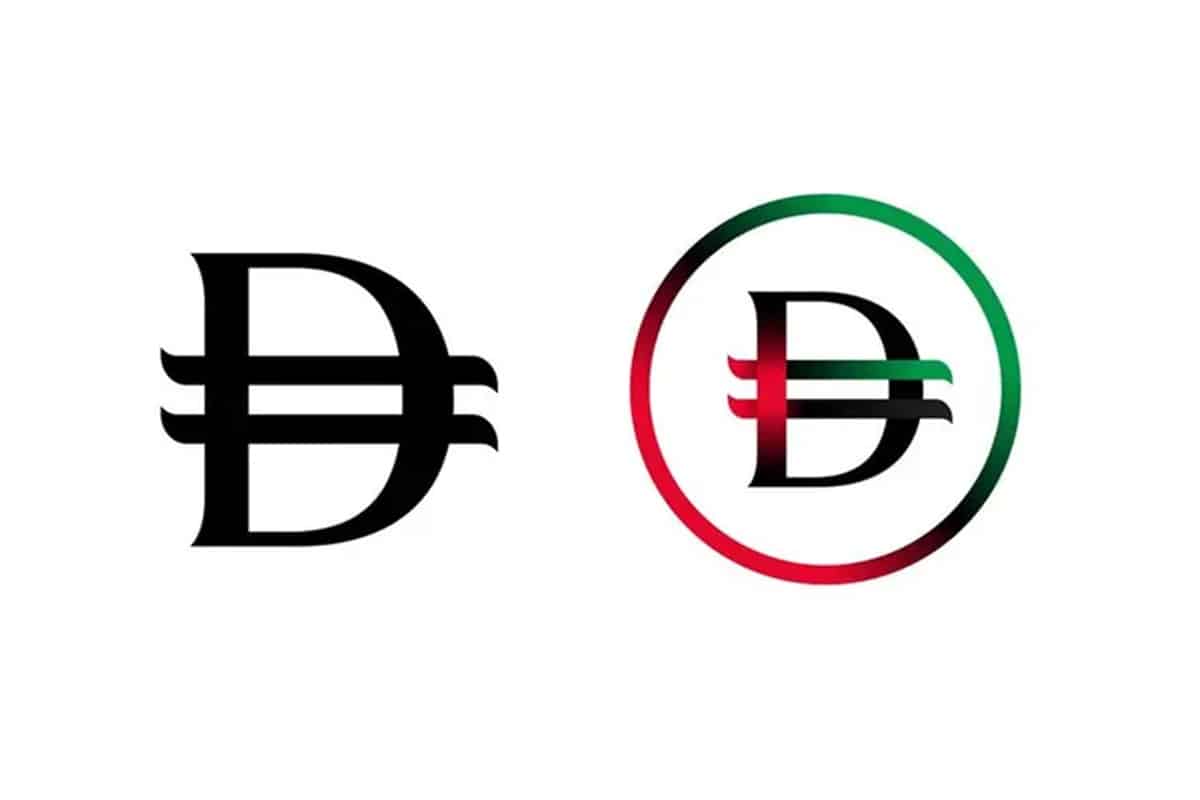
The currency operates on a permissioned blockchain platform called “Atha,” developed in partnership with UAE-based AI firm G42 and global blockchain specialist R3.9 It will be non-interest-bearing at launch to prioritize its use as a payment tool rather than a savings alternative.10 A new symbol for the Dirham—a stylized “D” with two horizontal lines inspired by the UAE flag—was unveiled in March 2025, applicable to both physical and digital forms.11

Image Source: UAE Dirham Symbol
Key Features and Use Cases
The Digital Dirham promises several advantages over traditional payment methods:
- Efficiency and Speed: Blockchain technology enables instant settlements, reducing transaction times from days to seconds. For instance, a AED 50 million cross-border payment with China was completed in just 7 seconds during trials via the mBridge platform.1213
- Cost Reduction: By eliminating intermediaries, it lowers fees for retail, wholesale, and international transfers—ideal for remittances, which are crucial for the UAE’s expatriate population.114
- Security and Traceability: Every transaction is recorded on a secure, tamper-proof ledger, minimizing fraud and enhancing anti-money laundering efforts.45
- Smart Contracts and Programmability: Users can automate payments, such as salaries or bills, through programmable features.139
- Tokenization: It supports fractional ownership of assets, boosting liquidity and financial inclusion.13
Use cases span retail payments (e.g., shopping, dining), wholesale interbank settlements, and cross-border transactions. The CBUAE is collaborating on projects like mBridge with partners including China, Thailand, and Hong Kong, and bilateral bridges with India.1516 By late 2025, it will be available for both retail and wholesale applications.3
How to Access the Digital Dirham
Access will be straightforward and integrated into existing financial systems. The Digital Dirham will be distributed through licensed financial institutions, including banks, exchange houses, finance companies, and fintech providers.213
- Digital Wallets: Users will download CBUAE-approved apps or use integrated bank apps to hold and transact Digital Dirhams. These wallets support QR codes, NFC contactless payments, and peer-to-peer transfers.1714
- Acquisition Process: Convert physical AED or other currencies via banks like First Abu Dhabi Bank, HSBC, or Standard Chartered, which participated in trials.2 Know Your Customer (KYC) verification, using documents like Emirates ID or passports, will be required.13
- Integration: It will be usable in stores, online, ATMs, and government services. For international users, access may come through partner platforms in mBridge-participating countries.1214
Eligibility extends to UAE residents, businesses, and potentially tourists, with even unbanked individuals able to participate through accessible fintech solutions.5
Value and Cost Comparison with Physical AED
The Digital Dirham maintains perfect parity with the physical AED—1 Digital Dirham equals 1 physical AED, with no premium or discount.45 This peg ensures it has the same purchasing power and stability.
However, it offers cost advantages:
- Transaction Fees: Digital transactions could be cheaper than traditional methods, with reduced intermediary costs. Cross-border payments via mBridge have demonstrated significant savings over systems like SWIFT.1516
- Acquisition and Usage: Loading wallets may involve minimal or no fees, unlike physical currency exchanges that often include markups (2-5% at banks or higher at airports).14 It avoids foreign transaction fees common with cards.
Overall, while the intrinsic value remains identical, the Digital Dirham’s efficiency makes it potentially less “expensive” to use in practice.1
Potential Challenges and Considerations
Despite its benefits, challenges include:
- Adoption Barriers: Not all merchants or ATMs may support it initially, requiring phased rollout.7
- Technical Requirements: Users need smartphones and internet access, which could exclude some demographics.18
- Privacy and Regulation: While secure, blockchain’s traceability raises privacy concerns, balanced by CBUAE’s focus on data protection.1920
- Competition: It coexists with stablecoins like the recently pre-approved AE Coin, a Dirham-pegged token.17
The CBUAE has addressed these through legislative updates ensuring legal tender status and ongoing pilots.5
Conclusion: A Step Toward a Digital Future
The Digital Dirham is more than a currency—it’s a catalyst for innovation, aligning with the UAE’s Digital Government Strategy 2025 and positioning the nation as a global fintech leader.173 By Q4 2025, it will enable faster, cheaper, and more secure transactions, benefiting residents, businesses, and the economy at large.112 For the latest updates, visit the CBUAE website or monitor announcements from participating banks.
As of August 22, 2025, preparations are advancing, with a comprehensive progress report released by the CBUAE on July 31, 2025.5 Stay informed to leverage this exciting development in UAE finance.
References
- Digital Dirham – CBDC Long Report (PDF) – Official CBUAE report on the Digital Dirham, published July 15, 2025.
- Central Bank Digital Currency Strategy – the Digital Dirham – UAE government page on the strategy, published September 5, 2023.
- Everything you need to know about the UAE’s planned Digital Dirham – Payment Expert article, published August 15, 2025.
- Digital Dirham – A Primer on the UAE’s Central Bank Digital Currency – SSRN paper providing an overview, published August 12, 2025.
- CBUAE launches strategy for Digital Dirham – Moody’s insights on the launch.
- Project Aber report (PDF) – Joint report on digital currency project.
- UAE aims to launch retail central bank digital currency this year – Global Government Fintech article, published April 1, 2025.
- CBUAE Annual Report 2023 (PDF) – Official annual report mentioning Digital Dirham.
- Central Bank Digital Currencies in the Middle East and Central Asia – IMF paper, published April 26, 2024.
- Central Bank Digital Currencies for Cross-Border Payments (PDF) – World Bank note on CBDCs.
- Digital Dirham: What compliance should know – LinkedIn article on compliance aspects, published March 27, 2025.
- Project mBridge: Connecting economies through CBDC (PDF) – BIS report on mBridge, published October 1, 2022.
- The digital assets opportunity in MENA (PDF) – EY report, published March 12, 2024.
- UAE’s ‘digital dirham’ opens door to new innovation – Pinsent Masons article, published August 14, 2025.
- Central bank digital currencies for cross-border payments (PDF) – BIS report.
- Central Bank Digital Currencies in the Middle East and Central Asia (PDF) – IMF detailed PDF.
- UAE – Digital Dirham and Dirham-backed Stablecoin – Lexis Middle East article, published May 6, 2025.
- Digital Dirham – Selected Issues and Policy Considerations – SSRN paper on policy issues, published August 12, 2025.
- UAE makes strides in crypto asset regulation – Fichte & Co article, published July 29, 2024.
- United Arab Emirates CBDC Tracker – Human Rights Foundation tracker.
Looking for reliable hosting with cheap price? Check our post here
Discover more from YuRaFa
Subscribe to get the latest posts sent to your email.



Leave a Reply